South Africa’s Triumph: A Reflective Moment for Team India
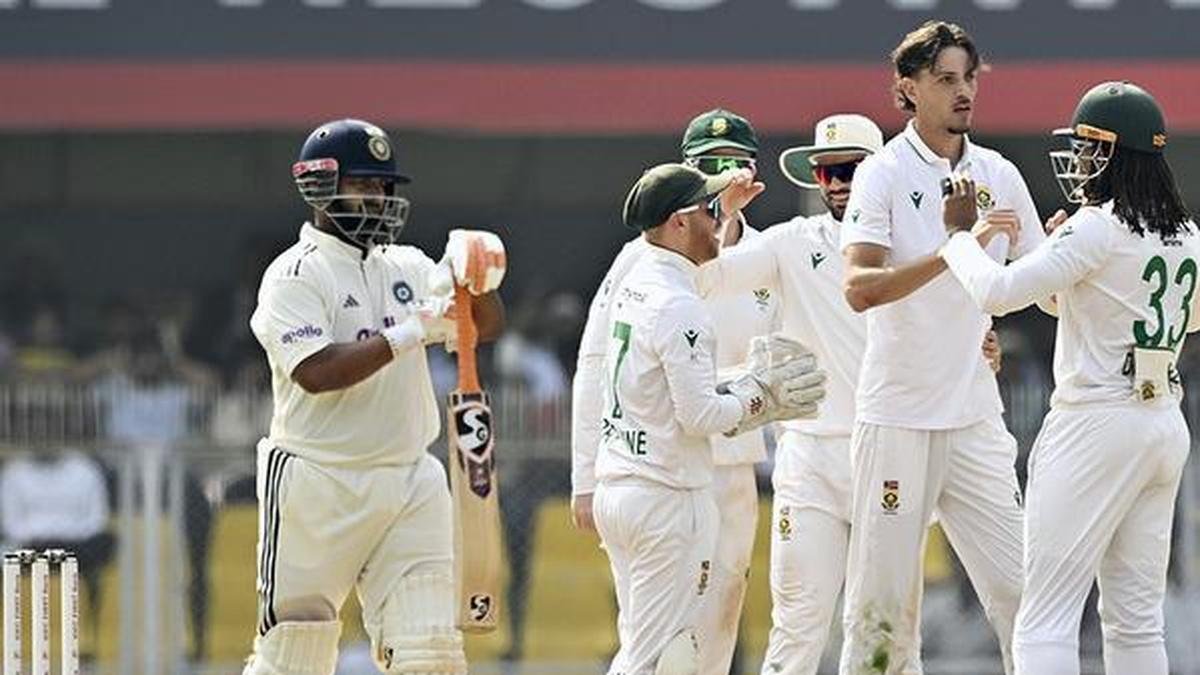
The period of denial has concluded.
India’s 2-0 Test series loss to South Africa at home signifies that last year’s defeat to New Zealand was not merely a one-time failure. This glaringly highlights the flaws riddling the current Indian Test team, effectively ending a prolonged era of dominance on home soil.
While one could generously attribute India’s loss in Kolkata partly to Shubman Gill’s unfortunate injury early in the Test, the small margin of South Africa’s victory could have been mitigated if the Indian captain had continued to bat.
India’s performance in the second Test, however, was nothing short of dismal. After a competitive opening day, India was outplayed consistently.
In the post-match press conference in Guwahati, Indian coach Gautam Gambhir defended his team by citing their inexperience against the Proteas.
Yet, leaning on the transitional phase as an excuse undermines the quality of players available to Gambhir. Jasprit Bumrah, Ravindra Jadeja, and Rishabh Pant, for example, are players who could easily be part of an all-time Indian Test XI. Additionally, Kuldeep Yadav is arguably the best left-arm wrist-spinner in Test history.
This series victory, South Africa’s first in India in 25 years, is their most significant validation since becoming World Test Champions earlier this year.
Such victories have been achieved by teams with fewer standout players, at least on home soil.
Central to India’s downfall was its fragile batting; across four innings against the Proteas, they surpassed 200 only once.
Indian batsmen were particularly troubled by off-spinner Simon Harmer, who took 17 wickets in the series at an astonishing average of 8.94.
It wasn’t just spin that posed a problem. In Guwahati, India’s weakness against short balls was exposed by Marco Jansen, who delivered a decisive spell in the first innings.
The home team also compromised itself by disrupting its batting order. Despite positioning B. Sai Sudharsan as the future No. 3, the Indian management replaced him for the first Test with Washington Sundar.
Washington, to his credit, was India’s most stable batsman in Kolkata, facing more deliveries on the challenging Eden Gardens pitch than any other teammate.
Gill’s injury caused further reshuffling in Guwahati—Sai Sudharsan returned to No. 3 while Washington was demoted to No. 8, despite his previous assured performance.
India’s batting issues were compounded by an overabundance of left-handed batsmen, an oversight until Harmer exploited it in Kolkata.
Even after Gill’s injury, the team chose not to add a specialist right-handed batsman, entering the second Test with all-rounder Nitish Kumar Reddy instead.
India’s persistence with Nitish highlights Gambhir’s preference for all-rounders, a concept borrowed from white-ball cricket.
While great all-rounders are invaluable in any format, Gambhir may have overestimated their significance in Test cricket, where specialized skills remain crucial.
Consider Nitish’s situation: despite being tapped as a pace-bowling option, he received minimal opportunities to bowl.
India bowled 229.4 overs in Guwahati, with Nitish delivering only 10. In the second innings, part-timer Yashasvi Jaiswal bowled before him.
Nitish also struggled with the bat, falling to Jansen’s bouncer and Harmer’s off-spin in successive innings.
If India aims to develop Nitish as a genuine pace all-rounder, placing him in the Test side for experience while underutilizing him is not the way forward.
This circles back to selection strategy—might India have fared better with a specialist batsman like Karun Nair, Sarfaraz Khan, or Ruturaj Gaikwad in Guwahati?
India’s insufficient preparation spilled onto the field. In Kolkata, despite witnessing South African captain Temba Bavuma navigate to success, Indian batsmen, barring Washington, struggled to adapt, ultimately faltering in a chase of 124.
In Guwahati, the tide turned against India on Day 2’s morning session. With South Africa at 246 for six on Day 1, many anticipated a swift end.
Yet, stand-in captain Rishabh Pant allowed Senuran Muthusamy and Kyle Verreynne to settle with defensive field placements, leading to a South African revival under Jansen’s aggressive batting.
Despite seeing the importance of overcoming the tricky morning session, Indian batsmen failed to show the same restraint as Muthusamy and Verreynne did.
Instead, they unraveled on Day 3, collapsing from 95 for one to 122 for seven in just 68 deliveries due to poor shot selection.
This inability to adapt was also evident individually, such as with Jaiswal.
Despite his known weakness against rising deliveries angling away, Jaiswal couldn’t resist the temptation, falling thrice to Jansen’s ill-advised cut shots.
While India’s shortcomings were clear, they faced a South African side performing near its peak, led by captain Bavuma and coach Shukri Conrad.
This victory, the first in India in 25 years, is South Africa’s strongest validation since being crowned World Test Champions.
Although South Africa benefited from key moments like Gill’s injury and winning both tosses, reducing their win to such factors would undermine their meticulous planning and execution.
In past decades, South Africa’s tours of India saw Indian spinners dominate.
This time, the roles reversed, with Proteas spinners, led by the relentless Harmer, outperforming their Indian counterparts.
South Africa also made successful selection decisions, such as choosing Corbin Bosch in Kolkata and recalling Muthusamy in Guwahati. Both contributed effectively with the bat and took crucial wickets.
Remarkably, South Africa secured this triumph without their star pacer, Kagiso Rabada, who missed the series due to injury.
It is worth noting that this historic win occurred in front of near-empty stands, continuing Guwahati’s lukewarm response to its first Test match.
Even on Day 2, a Sunday, Barsapara Stadium remained far from full. As India’s performance waned, so did the crowd’s enthusiasm.
More importantly, India struggled with Guwahati’s unfamiliar conditions, having almost no red-ball experience there.
While bringing Test matches to new venues like Guwahati broadens the appeal of red-ball cricket in India, it raises the question of whether compromising home advantage is worth it.
Yet, is the current Indian team even capable of leveraging such advantage?










Post Comment