Decoding India’s Trio: Unraveling the Strike Rate Enigma
WOMEN’S WORLD CUP 2025

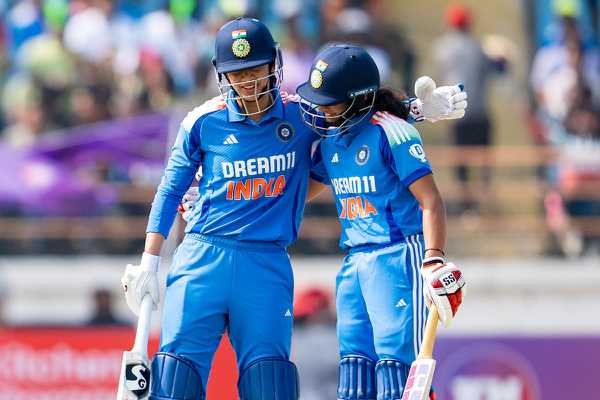
Rawal and Mandhana have achieved a run-rate of 6.05 in 19 ODIs together © BCCI
Five series before a home World Cup, India found a promising partner for Smriti Mandhana at the top – Pratika Rawal. Rawal had an immediate impact as an international cricketer. Before this, the team had finalized their one-down batter while touring Australia.
Harleen Deol reclaimed her spot in the national side at the crucial No. 3 position, steadying a role that had varied greatly after Mithali Raj’s retirement. With Harmanpreet Kaur at No. 4 and Jemimah Rodrigues at No. 5, India’s top-order was much more stable compared to the previous T20 World Cup.
During the home series against West Indies and Ireland, which neither team qualified for World Cup, Rawal and Deol found their form, each achieving their maiden ODI century. This, coupled with contributions from seasoned players, gave India’s top-five a formidable presence both on paper and scorecards.
While they blended in well during a World Cup year, most significant performances of Rawal and Deol came against familiar conditions and lenient opponents.
However, facing England in their home and Australia, the reigning champions, the top-order’s weaknesses became apparent once the runs were more challenging to come by.
The statistics tell their success story. The Rawal and Mandhana pairing has achieved a remarkable run-rate of 6.05 over 19 ODIs together. They are the only pair to maintain a run rate over a run-a-ball among 56 pairs with over 1000 partnership runs in WODIs.
Challenges begin once Mandhana falls early. The Rawal-Deol pair’s scoring rate drops to 4.31, in contrast to when Rawal falls first, where the Mandhana-Deol combination strikes at 6.39 RPO. When Mandhana outlasts her partners to partner with Kaur, their partnership rate spikes to a game-changing 7.82.
India’s Second-Wicket Partnership
| Batter | Innings | Runs | Balls Faced | Average | Run-rate | 100/50s |
|---|---|---|---|---|---|---|
| Rawal-Deol | 11 | 425 | 591 | 42.5 | 4.31 | 0/4 |
| Mandhana-Deol | 7 | 338 | 317 | 48.28 | 6.39 | 1/2 |
*since Rawal’s debut
The Rawal-Deol partnership’s brief innings at times stalls India’s momentum. A case in Southampton saw Mandhana’s early fall slow the rate significantly before the middle order steadied the pursuit.
Though Mandhana consistently performs by anchoring deep into innings, relying solely on her is unrealistic for long. Once she departs early, India’s strike rate with Rawal and Deol dips to 4.31, indicating a patent overdependence and exposes slowed run-rate due to their unproductive batting traits.
Deol’s Safety-First Approach
India’s heavy dot-ball usage is a critique affecting Mandhana as well. However, her capability to compensate with dominating strokes makes it forgivable—something the others cannot always promise. As a No. 3, Deol’s patience may become counterlogical when pressure mounts on the middle order by not converting her slow starts to meaningful scores.
In recent games, her entrance often resulted in stunted partnership. Against Australia, post a promising start, her 24-ball 10 was a far cry from expectations, leading to run-outs and subdued scoring rhythm.
Merely seven times in 22 innings has Harleen lasted beyond 10 overs. Her inability to escalate strike-rates post-being set affects innings momentum negatively.
Deol’s Innings Progression Since India Comeback
| Balls | Innings | Runs | Balls Faced | Run-rate | Strike-rate | Dismissals | Dot% | Boundary% |
|---|---|---|---|---|---|---|---|---|
| 0-30 | 22 | 345 | 552 | 3.75 | 62.5 | 7 | 64.1 | 7.24 |
| 31-60 | 15 | 294 | 325 | 5.42 | 90.46 | 8 | 45.5 | 9.84 |
| 61-90 | 7 | 99 | 83 | 7.15 | 119.27 | 5 | 33.7 | 14.45 |
| 91-120 | 1 | 30 | 13 | 13.84 | 230.76 | 1 | 30.7 | 53.84 |
Rawal’s Struggles Against Spin
Despite a promising career start, Rawal struggles against quality spin, especially in middle-overs. Her cautious approach curbs acceleration and hampers strike-rotation, allowing opponents to gain control over the match.
| Bowling | Innings | Runs | Balls Faced | Run-rate | Strike-rate | Dismissals | Dot% | Boundary% |
|---|---|---|---|---|---|---|---|---|
| Pace | 19 | 507 | 577 | 5.27 | 87.86 | 4 | 48.7 | 11.61 |
| Spin | 16 | 363 | 463 | 4.7 | 78.4 | 14 | 52.8 | 8.6 |
Her high dot-ball percentage and lower boundary percentages against spinners pose significant concerns, especially against left-arm spin. Her strike-rate falls significantly against this style of bowling, which has contributed to multiple dismissals in critical matches including the ongoing World Cup.
When Mandhana departs early, Deol and Rawal’s combined vulnerabilities hinder the run flow. Opponents have exploited this with targeted bowling strategies, leading India into challenging positions even against weaker opposition, a threat magnified against stronger teams.
As India enters the decisive stretch of the home World Cup, adaptation is crucial. Accountability and alignment between strategy and execution are necessary. Supporting a settled top order aligns with rewarding consistent shows, but balancing intent with consistency isn’t optional. India requires a dual approach at the top.
With statistical inputs from Roshan Gede
© Cricbuzz









Post Comment