Decoding the 2025-26 Vijay Hazare Trophy: From Vidarbha’s Triumph to India’s ODI Challenges
Here’s a rewritten version of the content:
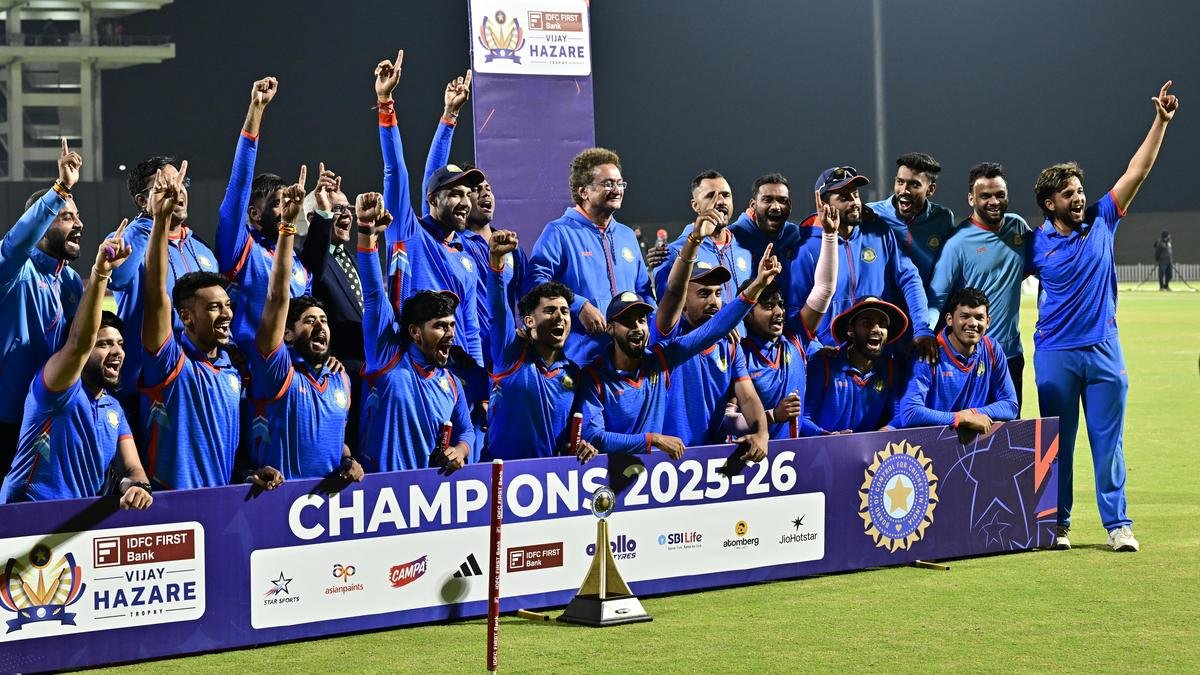
The 2025–26 Vijay Hazare Trophy (VHT) breathed new life into a format often criticized for its lack of excitement, showcasing a balanced contest between bat and ball, rising stars coming into their own, and a resurgence of India’s cricket elite. The climax of the tournament saw Vidarbha crowned champions for the first time.
Vidarbha, from southern Maharashtra, has built a strong reputation in red-ball cricket, winning three Ranji Trophy titles over the past eight years. They nearly clinched their first white-ball championship in 2025, driven by captain Karun Nair’s impressive 779-run season, but were defeated by Mayank Agarwal’s Karnataka in the final.
Despite Nair’s return to his home state prior to this season, Vidarbha was undeterred thanks to Aman Mokhade’s outstanding performance with the bat. The 25-year-old, coached by Mumbai’s Jwala Singh, who also trained Yashasvi Jaiswal, amassed 814 runs in 10 matches, hitting five centuries and coming just 16 runs short of N. Jagadeesan’s all-time seasonal record.
Pace bowlers Yash Thakur and Nachiket Bhute led Vidarbha’s bowling attack, taking 19 and 18 wickets respectively. Young all-rounder Harsh Dubey assumed the captaincy and led Vidarbha to their inaugural white-ball title, marking a historic achievement.
In the final, Vidarbha faced off against a strong Saurashtra team captained by young wicketkeeper Harvik Desai. The 26-year-old topped the scoring charts for Saurashtra with 581 runs at an average of 64.55. His opening partner, Vishvaraj Jadeja, added three centuries to the tally, including an unbeaten 165 in the semi-final against Punjab. Ankur Panwar led the tournament in wickets with 25 dismissals in 10 games, four of which came in the final, though Saurashtra ultimately finished as runners-up.
Vidarbha’s success with white-ball cricket underscores their team mentality. Coach Usman Ghani emphasizes resilience, highlighting the squad’s ability to rebound collectively after a setback. “We always believe in our ability to come back, and that’s what we instill in the team,” Ghani explains.
The squad’s depth and internal competition further bolster this resilience. While achievements in the Ranji Trophy, Duleep Trophy, and Irani Cup motivate the team, the strong bench ensures a lively environment. Ghani notes, “With players eager to seize opportunities, it simplifies our approach to tackling challenges.”
The team’s depth was evident when they excelled despite Dhruv Shorey missing the final and Danish Malewar sitting out the league phase due to injury.
Return of the Stars
Beyond Vidarbha’s triumph, the tournament held broader significance for Indian cricket. A break in the international schedule allowed national players to maintain their form with their state teams. As competition intensifies for spots in the 2027 ODI World Cup, the VHT became a pivotal stage for players to make their case for selection.
Rohit Sharma and Virat Kohli participated in the domestic arena, greeted by contrasting receptions. Rohit delighted a 10,000-strong crowd at Jaipur’s Sawai Mansingh Stadium with a quickfire 155 off 94 balls, his fastest List A century. Conversely, Kohli’s century in Bengaluru went largely unacknowledged as the BCCI Centre of Excellence did not admit spectators.
Other notable performances came from regular Indian players. Tilak Varma struck a century for Hyderabad against Chandigarh, while Sanju Samson notched his fourth List A century for Kerala against Jharkhand. Dhruv Jurel and Devdutt Padikkal’s strong seasons, yielding 558 and 725 runs respectively, bolstered their ODI aspirations. Hardik Pandya impressed with two explosive innings for Baroda, reinforcing his bowling credentials in a full spell against Chandigarh.
Shubman Gill’s comeback was postponed due to illness, limiting him to a single match for Punjab with limited impact. Rishabh Pant’s performance was underwhelming, scoring only two fifties in seven games for Delhi. On the bowling side, pacers Arshdeep Singh, Mohammed Siraj, and Prasidh Krishna made notable appearances before joining the ODI series against New Zealand.
Level Playing Field
The tournament’s intrigue extended beyond individual displays, with changes to playing conditions adding another dimension. A new rule requiring a single ball from the 35th over onwards reinvigorated death-over bowling strategies. Only five teams surpassed 400 runs in the tournament, including Bihar’s record-breaking 574 for 6 against Arunachal Pradesh in the Plate league.
Previous rules, such as four fielders outside the circle during the second PowerPlay and the use of two balls per innings, limited bowlers’ effectiveness. The latest rule change gives fast bowlers a chance for reverse swing late in the innings under conducive conditions.
Bengal spinner Shahbaz Ahmed noted, “Our bowlers have started getting some reverse swing since the BCCI implemented the new rule. It allows for movement in the last ten overs, giving bowlers a chance to counter batters late on.”
India’s recent ODI series loss to New Zealand has reignited discussions about the national team’s formation for 2027. The 2025–26 VHT demonstrated that domestic talent is poised to fill any gaps, offering potential options for selectors considering a strategic shift.
Published on January 23, 2026









Post Comment